
When we talk about innovation, we tend to count what is easy to see: patents filed, products launched, companies founded, dollars raised. Those measures matter. But they leave a harder question unanswered: did the product, service, or practice make life better for people and communities?
That question ran through the Washington State Academy of Sciences’ Thought Leaders Seminar Series this fall. In September, three webinars brought together nine national and state leaders to explore innovation for public value in regional innovation ecosystems, energy, and health. On October 8, at WSAS’s Annual Member Celebration, state leaders joined WSAS members to continue the conversation in person.
Early in the series, Jodi Sandfort, Dean of the Evans School of Public Policy & Governance at the University of Washington, offered a definition of innovation drawn from sociology and organizational science rather than economics: how do new ideas come into a context where they haven’t been used before? By that standard, a discovery is only the beginning. The real work is moving good ideas (or insights or technologies) into practice.
Innovation with a purpose
The first webinar laid the foundation for the series. Barry Bozeman, professor emeritus at Arizona State University, distinguished conventional innovation (new goods and services for economic growth and jobs) from public value innovation (goods or services that benefit the population broadly). Examples of the former include GPS technology or pharmaceuticals and the latter include improved water treatment or access to healthcare. Conventional innovation “can be extremely beneficial,” he said, “but it is not, by definition, beneficial.” It is generally driven by private actors without broad input or accountability for societal impact. Public value, he added, is “sector agnostic.” While government is often the instrument for achieving it, public value can be created by any sector. A key question is whether we can foresee benefits and risks of innovations and be more intentional about achieving or avoiding them.
Erwin Gianchandani, Assistant Director for Technology, Innovation, and Partnerships at the National Science Foundation, described federal programs that pair the “push” of research with the “pull” of real-world demand, letting communities and regional partners help shape research questions. The key to their success, he said, ‘all comes down to the people,’ and their willingness to work across boundaries of field, sector, and geography. New technologies can’t survive without a supportive social ecosystem.
“It all comes down to the people. You have to have individuals who have a particular vision … and a willingness … to work across, oftentimes, boundaries that are difficult to transcend, whether it be fields, whether it be sectors, whether it be geographies.”
Erwin Gianchandani, Assistant Director for Technology, Innovation, and Partnerships at the National Science Foundation
Sandfort then asked how well Washington lives up to its reputation. The state is known for innovation, but that reputation does not fully extend to its public systems. For example, of roughly 100 innovations the state’s justice system has invested in over 80 years, many were launched on intuition rather than evidence and none achieved statewide take-up. Sandfort sees an opening for researchers, especially at public universities, to start from the real problems of a place and produce “knowledge for action.” Universities have built infrastructure for discovery and commercialization, she observed, “but we haven’t really built infrastructure around public impact.”
Energy: the innovation is in the connections
Sandfort’s call to start from the real problems of a place carried into the energy webinar. Panelists argued that meeting Washington’s energy needs depends less on the next breakthrough technology than on how many institutions work together. Debra Smith, former CEO of Seattle City Light, noted that the grid’s pieces “may be managed separately, but electrically, they are one system,” and no single organization is in charge of the whole. The real challenge, she said, is ‘getting many smart people and many smart institutions to act on a shared picture and a shared vision.’
“The challenge is not a shortage of smart people. It’s getting many smart people and many smart institutions to act on a shared picture and a shared vision.”
Debra Smith, former CEO, Seattle City Light
Kurt Beckett, Chair of the Washington State Energy Facility Site Evaluation Council, made a similar point about information: “We do not lack data,” but it is not well integrated. He mentioned the gap between what we know we need and delivery. There is a need to integrate many small assets and new technologies into an interconnected system. Another issue is how to deliver projects at the pace needed to meet demand. “Time needs to be valued as a public resource,” he said.
David Hart of the Council on Foreign Relations cautioned against waiting for a single breakthrough: “We shouldn’t put all our weight on fusion or geothermal to come to the rescue.” Demand management, distributed resources, and better transmission all have a role.
Smith sees Washington, with its clean energy supply, public power tradition, and research institutions, as an “extraordinary laboratory for institutional innovation.” She proposed an outcome-based pilot: pick a real infrastructure need, set the date it is needed, and work backward through every decision to see what could change, building trust along the way.
Beckett agreed: “No utility needs every solution if they can access broader assets across a region.” The biggest challenge is how to achieve benefits of scale without losing local accountability.
Health: community engagement comes first
In health research, the field of implementation science studies how new insights move into practice. An effective intervention rarely reaches patients on its own. As David Chambers, director of implementation science at the National Cancer Institute put it, it still “takes way too long to turn way too little of what we’ve researched” into better care. He urged researchers to ask early, not after all the testing is done, whether people can actually use an intervention.
Stephen Friend, CEO of the nonprofit 4YouandMe, asked who should be driving research in the first place, describing rare disease projects led by patients. He wonders whether scientific insights might eventually come from patients themselves; with the right data can they understand what’s making them better or worse?
Amanda Boyd, director of Native American Programs at Washington State University argued that community engagement is the foundation of research, not its final step. Trust is earned through action. It takes showing up and following up, even when a grant isn’t attached to it. Researchers need to understand what communities care about. “When research fails to make an impact, it usually isn’t because the science is wrong, it’s because we didn’t understand the context.”
“When research fails to make an impact, it usually isn’t because the science is wrong, it’s because we didn’t understand the context.”
Amanda Boyd, Director of Native American Programs at Washington State University and WSAS Board Member
What state leaders asked of researchers
Senator Boehnke and Representative Ryu
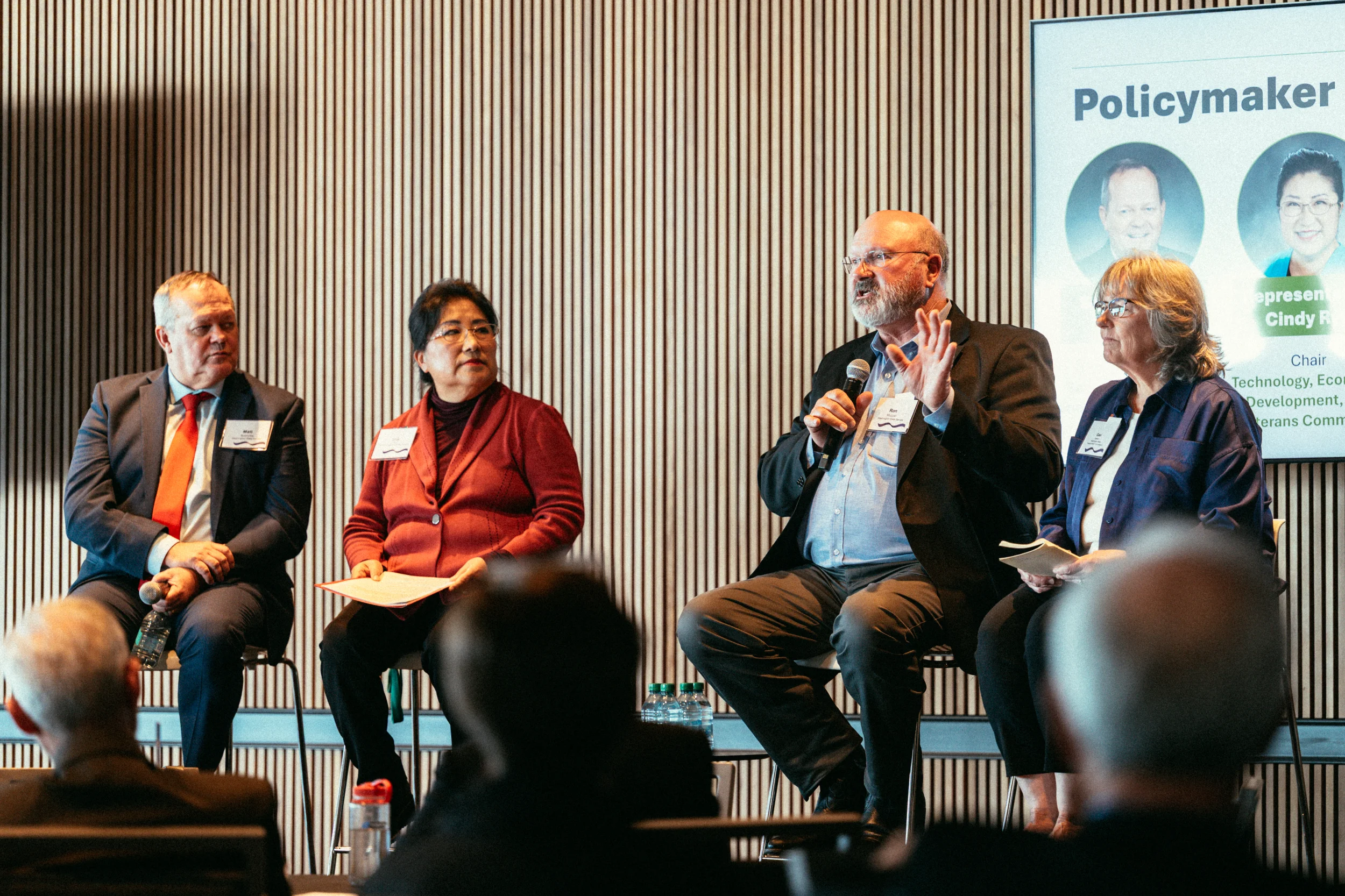
On October 8, four state leaders described challenges facing Washington that involve competing goals. Senator Matt Boehnke spoke about rising energy demand and preparing the next generation for an AI-driven economy. Representative Cindy Ryu focused on wildfire and flood preparedness in a tight budget year. Senator Ron Muzzall described rising health care costs and strained rural hospitals. Their common request was for researchers to bring their expertise early and help make decisions people can trust.
Gael Tarleton, a former state representative now on the Washington State Transportation Commission, named what she sees as a central challenge: “People do not know who they can trust. And they don’t know why they should trust us.” Her advice to researchers: engage the public early and treat a first policy proposal as a hypothesis rather than an end point.
Sandfort added that research rarely hands policymakers a ready-made solution. It is more valuable when it changes how people think about a problem, but without trusted relationships research can be cherry-picked to support an argument. “We have to get better at helping people take knowledge into action,” she said.
“We have to get better at helping people take knowledge into action.”
Jodi Sandfort, Dean of the Evans School of Public Policy & Governance, University of Washington
At their tables, participants returned again and again to trust. As one put it, “Be a trusted person first, then the science will be trusted.” Others called for academic reward systems that recognize public impact and for field tours where researchers learn from policymakers.
Science & engineering in service to Washington
WSAS started this series by asking how science and engineering can make life better for people and communities in Washington. Over four sessions, speakers and participants came at that question from very different angles, but they kept returning to the same point: a good idea only matters if it takes hold where it’s needed. Getting there depends on relationships and trust, and on people willing to work outside their own field or institution.
Those are the same commitments behind WSAS’s mission to put science and engineering in service to Washington. Insights drawn from this series will help shape upcoming Academy work in energy, health, and beyond. Recordings of the webinars and the October 8 panel are available on the WSAS YouTube channel and linked on our website.
The Thought Leaders Seminar Series was made possible by the generous support of the Hoveida Family Foundation. Quotes have been lightly edited for clarity.
Related Posts
October 28, 2026
The WSAS Thought Leaders Seminar Series brought together national and state experts, legislators, and WSAS members to ask how research and innovation can better deliver public benefit in Washington, with examples from energy and health.
October 26, 2026
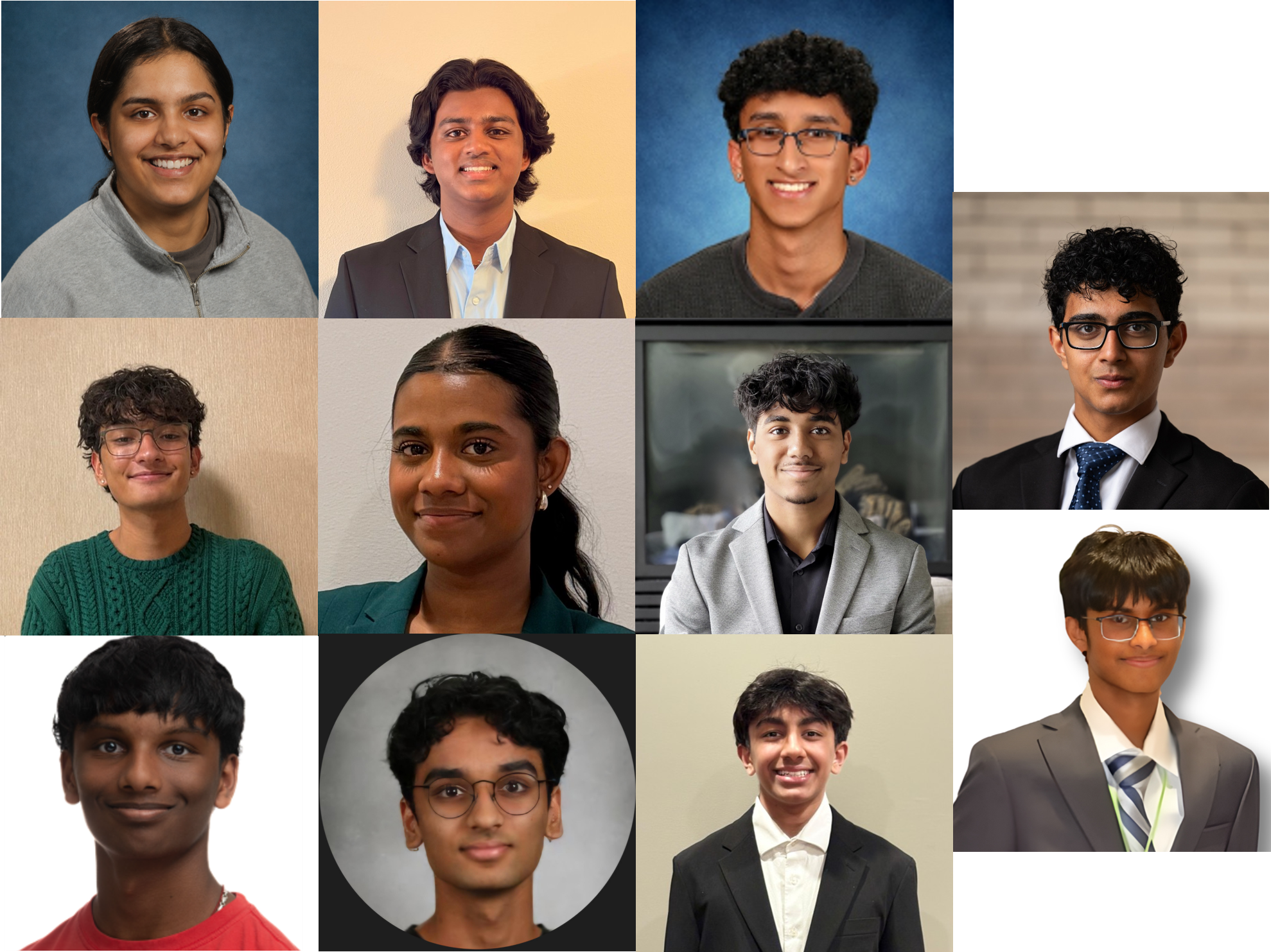
High school students from across the state were recognized for their outstanding original scientific research.

October 14, 2026
Research and findings focus on measuring and maximizing the value distributed solar and energy storage can deliver for Washington state.
